|
Emergency Contingency Procedures ECP Training & Drills – Lifeboats |
Doc No.: ECP 04-02
Revision: 01 Date: 15 Oct 2024 Issued by: DPA Approved by: MD |
4.4.1Guidelines on Safety During Abandon Ship Drills Using Lifeboats
(MSC.1/Circ.1578 supersedes only Annex 2 of MSC Cir. 1206 rev, relevant section of which are given below.)
4.4.1.1 Introduction
(a) It is essential that seafarers are familiar with the life-saving systems on board their ships and that they have confidence that the systems provided for their safety will work and will be effective in an emergency. Frequent periodic shipboard drills are necessary to achieve this.
(b) Crew training is an important component of drills. As a supplement to initial shore-side training, on board drills and training will familiarize crew members with the ship appliances and the associated procedures. The objective of drill and training is to develop appropriate crew competencies, enabling effective and safe utilization of the equipment required by SOLAS. The time limits set out in SOLAS for ship abandonment should be considered as a secondary objective when conducting drills.
4.4.1.2. Drill Frequency
(a) Experience has shown that holding frequent drills furthers the goals of making the crew familiar with the life-saving systems on board their ships and increasing their confidence that the appliances will work and will be effective in an emergency. Drills give the crew opportunity to gain experience in the use of the safety equipment in co-operation. The ability to cope with an emergency and handle the situation is improved by frequent drills.
(b) However, frequent crew changes sometimes make it difficult to assure that all on board have had the opportunity to participate in drills if only the minimum required drills are conducted. Therefore, consideration needs to be given to scheduling drills as necessary to ensure all on board have an early opportunity to become familiar with the ship appliances and systems.
4.4.1.3 Drills Must Be Safe
(a) Abandon ship drills should be planned, organized and performed in accordance with relevant shipboard requirements of occupational safety and health so that the recognized risks are minimized.
(b) Drills provide an opportunity to verify that the life-saving appliances are working and that all associated equipment is in place, in good working order, ready for use.
(c) Before conducting drills, it should be checked that the lifeboat and its equipment have been maintained in accordance with the ship's maintenance manuals and any associated technical documentation, as well as noting all the precautionary measures necessary. Abnormal conditions of wear and tear or corrosion should be reported to the responsible officer immediately.
4.4.1.4 Emphasis on Learning
Drills should be conducted with an emphasis on learning and be viewed as a learning experience, not just as a task to meet a regulatory requirement to conduct drills. Whether they are emergency drills required by SOLAS or additional special drills conducted to enhance the competence of the crew members, they should be carried out at safe speed. During drills, care should be taken to ensure that persons on board familiarize themselves with their duties and with the equipment. If necessary, pauses should be made during the drills to explain especially difficult elements. The experience of the crew is an important factor in determining how fast a drill or certain drill elements should be carried out.
4.4.1.5 Planning and Organizing Drills
(a) SOLAS requires that drills shall, as far as practicable, be conducted as if there was an actual emergency (refer to SOLAS Reg III/19.3.1). This means that the entire drill should, as far as possible, be carried out, while ensuring that the drill can be carried out in such a way that it is safe in every respect. Consequently, elements of the drill that may involve unnecessary risks need special attention or may be excluded from the drill.
(b) Lifeboats should not be lowered when vessel is underway at sea even to embarkation deck during the drills. But at the same time all opportunities must be utilized at Anchorage or while alongside to lower the boats to embarkation deck to confirm the smooth working of all moving parts. There should be enough time to carry out the launching/ retrieving operation.
(c) In preparing for a drill, those responsible should review the manufacturer’s instruction manual to assure that a planned drill is conducted properly. Those responsible for the drill should assure that the crew is familiar with the guidance provided in the life-saving system instruction manual.
(d) Lessons learned during a drill should be documented and made a part of the follow-up shipboard training discussions and planning the next drill session.
(e) The lowering of a boat with its full complement of persons is an example of an element of a drill that may, depending on the circumstances, involve an unnecessary risk. Such drills should only be carried out if special precautions are observed.
4.4.2. Abandon Ship Drills
4.4.2.1. Introduction
It is important that the crew who operate safety equipment on board are familiar with the functioning and operation of such equipment. SOLAS requires that sufficiently detailed manufacturers’ training manuals and instructions be carried on board, which should be easily understood by the crew. Such manufacturers’ manuals and instructions should be accessible for everyone on board and observed and followed closely when preparing and conducting drills.
4.4.2.2. Lifeboats Lowered by Means of Falls
(a) During drills, everyone participating should be alert for potentially dangerous conditions or situations and should bring them to the attention of the responsible person for appropriate action. Feedback recommendations to the Office, the Administration and the system manufacturer are important elements of the marine safety system.
(b) When drills are to be performed with persons on board the lifeboat, it is recommended that the boat be lowered and recovered without any persons on board first to ascertain that the arrangement functions correctly. In this case, the boat should then be lowered into the water with only the number of persons on board necessary to operate the boat as per SOLAS Reg III/19.
(c) Since 3 persons are considered as minimum for maneuvering the Lifeboat as part of three monthly SOLAS drill, most of the vessel’s Lifeboat Davit winch will have limitation for retrieving boat with maximum 3 persons for the Lifeboat and maximum 6 persons for the Life Boat when used in Rescue Boat mode as per Maker’s instructions. Therefore, vessel’s Lifeboat Davit winch manual must be checked for maximum number of persons allowed in the boat for retrieving the lifeboat and at no time Lifeboats should be retrieved with more than the maximum persons allowed.
(d) Retrieving capacity/no. of persons should be stenciled at the davits.
(e) To prevent lashings or gripes from getting entangled, proper release should be checked before swinging out the davit.
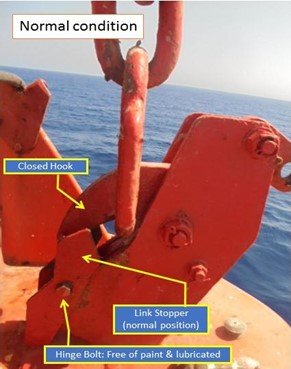
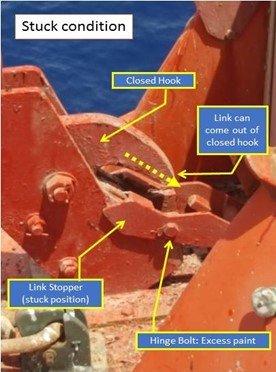
(f) On Enclosed Lifeboat & Rescue Boats, free movement of the Link Stopper to be confirmed for lifeboat hook’s Link Stoppers prior every lowering into the water including lowering it to deck level monthly.
4.4.2.3 Free-fall Lifeboats
(a) The monthly drills with free-fall lifeboats should be carried out according to the manufacturer’s instructions, so that all the persons who are to enter the boat in an emergency are trained to embark the boat in an emergency, to take their seats in a correct way and to use the safety belts; as well as being instructed on how to act during launching into the sea.
(b) When the lifeboat is free-fall launched as part of a drill, this should be carried out with the minimum personnel required to maneuver the boat in the water and to recover it. The recovery operation should be carried out with special attention, bearing in mind the high-risk level of this operation. Where permitted by SOLAS regulation III/20.11.2, simulated launching should be carried out in accordance with the manufacturer’s instructions taking due note of the Guidelines for simulated launching of free-fall lifeboats, as set out in the appendix.
4.5. Guidelines for Periodic Servicing and Maintenance of Lifeboats, Launching Appliances, and On-load Release Gear
Please refer to SOLAS III/1.5 MSC.317(89)
4.6. Guidelines for Simulated Launching of Free-Fall Lifeboats
Please refer to the latest SOLAS circular on above as attached in the annex MSC.1/Cir.1578, Annex page 4, MSC/Circ.1137
4.6.1. Conduct of Drills - Typical Simulated Launching Sequence (SOLAS Reg III/19)
(a) Check equipment and documentation to ensure that all components of the lifeboat and launching appliance are in good operational condition.
(b) Ensure that all personnel involved in the drill are familiar with the operating manuals, posters, and signs.
(c) Ensure that the restraining device(s) provided by the manufacturer for simulated launching are installed and secure and that the free-fall release mechanism is fully and correctly engaged.
(d) Establish and maintain good communication between the assigned operating crew and the responsible person.
(e) Disengage lashings, gripes, etc., installed to secure the lifeboat for sea or for maintenance, except those required for simulated free-fall.
(f) Participating crew will board the lifeboat and fasten their seatbelts under the supervision of the responsible person.
(g) All crew disembark the lifeboat.
(h) Return the lifeboat to the condition it was in prior to step provided in paragraph d). Ensure that the lifeboat is returned to its normal stowed condition. Remove any restraining and/or recovery devices used only for the simulated launch procedure.
4.7. Fall Preventer Device (FPD)
(a) A “Fall Preventer Device” (FPD) must be used to minimize the risk of injury or death by providing a secondary alternate load path in the event of failure of the on-load hook or its release mechanism or of accidental release of the on-load hook. However, FPDs should not be regarded as a substitute for a safe on-load release mechanism.
(b) Wires or chains should not be used as FPDs, as they do not absorb shock loads. The following points should be considered when synthetic strops or slings are used as FPDs:
- (i) The strops or slings should be issued with an appropriate Certificate documenting a tensile strength which provides for a factor of safety of at least six, based on the total weight of the lifeboat when loaded with its full complement of persons and equipment.
- (ii) The strops or slings should be inspected before use and thoroughly inspected by ship’s crew every six months. The material of the strop or sling should be rot-proof, corrosion-resistant, not be unduly affected by seawater, oil or fungal attack, and UV resistant. The strops or slings should be permanently marked with the date of entry into service.